Showing posts with label composer. Show all posts

Friday, November 8, 2013

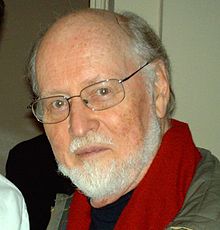
Composer Spotlight: John Williams

These days, the movie industry creates a place for many composers and musicians to create new music that the whole world will hear. This music is used to tell a story, to set the scene, and to bring up emotional feelings like happiness, sadness and danger for the people who are listening and watching.

John Towner Williams, Jr. was born in 1932. He is a very successful film composer. Today he is considered to be one of the best film composers of all time! He has won 5 Academy Awards, but has been nominated 48 times for the award. The only other person to be nominated more times for this award is Walt Disney. He has also won many other awards.

Mr. Williams is a composer, conductor and a pianist. He has been working as a musician in these ways for over 60 years, and is still composing today. 

Here are just a few of the movies he has written music for:
     Jaws
     Indiana Jones 
     Star Wars
     Superman
     E.T., the Extra-Terrestrial
     Schindler's List
     Harry Potter
     The Adventures of Tintin

He also wrote the theme song for some of the Olympic Games.

Writing music for a movie takes a lot of work! The director of the movie meets with the composer to tell them about the movie and to show them the film. Then the composer must create themes for the movie. Mr. Williams composes these themes on the piano first. Later he will score them for an orchestra to play. Once the orchestra learns the music, Mr. Williams conducts the music while watching parts of the movie so that he can make the film and the music go together. He and the director must work to make sure the music and the video do the best possible job of telling the story of the movie.

Below is a video of John Williams talking about working with director Steven Spielburg on the movie E.T., the Extra-Terrestrial. This movie came out in 1982, and today it is considered to be a classic. John Williams won an Academy Award for Best Original Score for this movie. 


Tuesday, September 17, 2013

Composer Spotlight: J.S. Bach

In the next few months, we will be focusing on different composers and their works. 

Johann Sebastian Bach was born in 1685 in the country of Germany. He is part of the Baroque period of music. 

Although the piano as we know it did not exist in that time, there were other keyboard instruments that Bach played on and composed music for. Bach composed many pieces for the organ and the harpsichord. In total, Bach wrote more than a thousand compositions. 

He is considered to be one of the greatest composers of all time, not just because of how many pieces he composed, but because of the musicianship that is required to play the pieces and how much people have enjoyed his music. Imagine if people were still enjoying and playing your music more than 200 years after you wrote it!

In the video below, you can watch organist Hans-Andre Stamm perform one of Bach's most famous pieces of music - the Toccata and Fugue in D minor. 

This is a huge organ, with hundreds of pipes that create high sounds, low sounds, trumpet sounds, reed sounds, and other sounds. The pipes are controlled by levers on the side of the keyboards called stops. The ones that are pulled out further than the others are the ones he is currently using. Look how many more stops there are! 

There are even stops that go with the keys that the feet play. Imagine if you pulled out all the stops...how loud and incredible a sound you would get! This is where the phrase "pull out all the stops" comes from.


The second video is Bach's Prelude and Fugue number 2 from a collection of preludes and fugues called The Well-Tempered Clavier. Anthony Newman is playing it on the harpsichord. You will notice that this instrument also has more than one keyboard. Like the piano, it has strings, but the harpsichord plucks the strings instead of hitting them, which creates a very different sound from the piano. 


Friday, June 21, 2013

Composer Spotlight: Jeff Raught

Today I would like to introduce a fellow musician and composer here in Lancaster, Pennsylvania.
  
Jeff Raught is a funny, creative, talented artist. His main instrument is piano and he plays in a fun and unique style. On his website, Jeff describes the kind of music he plays as "a little jazz, a little laid back, some fun. I don't really know."  
Jeff didn't have much formal training in music, but he loves to improvise. His performances are always fun.

He is also a comedian, so some of his songs are very funny. He performs with Ted Swartz in the group Ted and Company.

For example, here is his song entitled, "Manna". It is based on the story of the Israelites who were travelling in the desert and had run out of food. God fed them with manna every day...for years and years.

Manna


Here is an example of his music for piano from his album In the Midst. I enjoy listening to this album because it makes me feel relaxed and peaceful.

Autumn Daze


You can listen to and download his music for free here.  Check it out!

You can go to a performance by Jeff Raught on July 28 at Hanover Brethren in Christ Church or on August 17 at Laurelville Mennonite Church Center.  See the complete information here.

Friday, January 18, 2013

Composing Vocabulary

This week we began our composing adventure! Here is a review of some of the vocabulary and ideas we talked about in group classes:

Phrase: A musical phrase is like a sentence written with notes. 
    You can create a complete musical phrase by writing a "question" and an "answer." 
    In the key of C, I told you to make the question end on G so that it sounds like we need to keep going.
    The answer will end on C, which will make it sound like a finished phrase (or sentence).

Word painting: Word painting (sometimes called tone painting) is when you write music that makes a sound to describe what the words are saying. 
   For example, if the words talk about going up, you can make the notes go up higher on the piano.  Or, if the words are about a bouncy ball, you could choose to write some staccato notes to create the sound of the bounces.

ABA form: This is called ternary form. There are three sections to the song and the first and last sections are very similar. The middle section can sound quite different; it contrasts with the A section.
   Two examples of Suzuki songs with this form are Chant Arabe in Book 1 and Ecossaise in Book 2.
   You can create a simple ABA song in the following way:

  1. Write a phrase (question and answer). This is the A section.
  2. Write a different phrase (different question and answer). This is the B section.
  3. Repeat the A section.
You can make the song longer by putting more than one phrase in a section.


Time signature: This sign is placed at the beginning of the song, next to the clefs. It tells us how many beats are in a measure and what note gets 1 beat. 

Enjoy creating your own music!

Friday, January 4, 2013

Composing Online


   This spring we are going to compose our own music. We are composing music when we choose the notes, rhythms and dynamics (how loud and soft) to make a song. A person who composes music is called a composer.

   You can look in your Suzuki music book for the names of some composers whose songs you know how to play. Look at the right side of the page underneath the title. 
     What is the name of the composer who wrote the song you are learning right now? 

(Sometimes it will say "Folk Song" or "Anonymous". This means we don't know who the composer is.)

    People share the music they composed in different ways. One way is to play the song for another person. They can also teach another person how to play their song by showing them how to do it. One of the main ways people share the music they have composed is by writing it down using notes on the staff. That way, anyone who knows how to read music can learn to play their song, even if they never meet the composer!

   The link below leads to a fun game to play online that lets you compose a very short song. All you have to do is drag notes onto the staff. When the note turns green, you can let go and it will be written on the staff. Once you fill the measures with notes, you can have the computer play your song. 

   Compose some music on this game. Pick your favorite song and click "Send to my friend". Send it to me at laura@kautzstudio.com and I will be able to hear your song too!

(If you are in book 2 or 3, be sure to click on the "Advanced" button so that you have more note choices.)

Compose Your Own Music Here at Classics for Kids

Thursday, November 15, 2012

Composer Spotlight: Phillip Keveren

  Today I begin a new series of posts about composers.  I plan to feature a different composer every now and then and provide examples of their music.  

  Today's composer is a contemporary composer who is still actively composing music today.  His name is Phillip Keveren.  

   According to the website phillipkeveren.com, Mr. Keveren composes in many different genres.  A genre  of music is a style or kind of music.

  Mr. Keveren has written piano music for the Hal Leonard Student Piano Library. He also has books of music called The Phillip Keveren Series. Some of you may have played some of his piano music.  
(You can find a list of some of his music here.)
  
  Piano music is not the only kind of music Mr. Keveren writes. He also creates orchestrations or music that is made for an orchestra to play.

In the videos below, you can watch performances of some of Phillip Keveren's piano music. Which pieces do you like the most?  Is there a piece you would like to learn someday?

Quick Spin in a Fast Car


Blue


A Misty Morning

All of these pieces were performed by Dr. Alan Huckleberry for The University of Iowa Piano Pedagogy Video Recording Project. This is a current project and they are adding piano music to it every week with the goal of recording 9,000 piano pieces that students can learn to play.